Once in a while, you’ll be asked to do a movie review essay. This task is a great training tool for enhancing critical thinking skills. Essays on movie review aim at presenting a film from the most important scenes, special effects, to exciting moments and may be accompanied by criticism میهن بلاگ، ابزار ساده و قدرتمند ساخت و مدیریت وبلاگ. با قابلیت نمایش آمار، سیستم مدیریت فایل و آپلود تا 25 مگ، دریافت بازخورد هوشمند، نسخه پشتیبان از پستها و نظرات Dear Twitpic Community - thank you for all the wonderful photos you have taken over the years. We have now placed Twitpic in an archived state
Movie Review Essays - Examples of Film Review Research Papers - GradesFixer GradesFixer
Petrarch's rediscovery of Cicero 's letters is often credited with initiating the 14th-century Italian Renaissance and the founding of Renaissance humanism. Petrarch's sonnets were admired and imitated throughout Europe during the Renaissance and became a model for lyrical poetry.
He is also known for being the first to develop the concept of the " Dark Ages ," [4] which most modern scholars now find misleading and inaccurate.
Petrarch was born in the Tuscan city of Arezzo on 20 July He was the son of Ser Petracco and his wife Eletta Canigiani. His given name was Francesco Petracco, which was Latinized to Petrarca. Petrarch's younger brother was born in Incisa in Val d'Arno in Dante Alighieri was a friend of his father.
Petrarch spent his early childhood in the village of Incisanear Florence. He spent much of his early life at Avignon and nearby Carpentraswhere his family moved to follow Pope Clement Vwho moved there in to begin the Avignon Papacy.
Petrarch studied law at the University of Montpellier —20 and Bologna —23 with a lifelong friend and schoolmate called Guido Sette.
Because his father was in the legal profession a notaryhe insisted that Petrarch and his brother also study law, 12 angry men essays. Petrarch, however, was primarily interested in writing and Latin literature and considered these seven years wasted.
Additionally, he proclaimed that through legal manipulation his guardians robbed him of his small property inheritance in Florence, which only reinforced his dislike for the legal system. He protested, "I couldn't face making a merchandise of my mind," as he viewed the legal system as the art of selling justice. Petrarch was a prolific letter writer and counted Boccaccio among his notable friends to whom he wrote often.
After the death of their parents, Petrarch and his brother Gherardo went back to Avignon inwhere he worked in numerous clerical offices. This work gave him much time to devote to his writing. With his first large-scale work, Africaan epic in Latin about the great Roman general Scipio AfricanusPetrarch emerged as a European celebrity. On 8 Aprilhe became the second [9] poet laureate since classical antiquity and was crowned by Roman Senatori Giordano Orsini and Orso dell'Anguillara on the holy grounds of Rome's Capitol.
He traveled widely in Europe, served as an ambassador, and because he traveled for pleasure, [13] as with his ascent of Mont Ventoux has been called "the first tourist ". He encouraged and advised Leontius Pilatus 's translation of Homer from a manuscript purchased by Boccaccio, although he was severely critical of the result.
Petrarch had acquired a copy, which he did not entrust to Leontius, [15] but he knew no Greek ; Petrarch said, "Homer was dumb to him, while he was deaf to Homer". Disdaining what he believed to be the ignorance of the centuries preceding the era in which he lived, Petrarch is credited or charged with creating the concept of a historical " Dark Ages ". Petrarch recounts that on 26 Aprilwith his brother and two servants, he climbed to the top of Mont Ventoux 1, meters 6, fta feat which he undertook for recreation rather than necessity.
In it, Petrarch claimed to have been inspired by Philip V of Macedon 's ascent of Mount Haemo and that an aged peasant had told him that nobody had ascended Ventoux before or after himself, 12 angry men essays, 50 years before, and warned him against attempting to do so. The nineteenth-century Swiss historian Jacob Burckhardt noted that Jean Buridan had climbed the same mountain a few years before, and ascents accomplished during the Middle Ages have been recorded, including that of Anno II, Archbishop of Cologne.
Scholars [21] note that Petrarch's letter [22] [23] to Dionigi displays a strikingly "modern" attitude of aesthetic gratification in the grandeur of the scenery and is still often cited in books and journals devoted to the sport of mountaineering. In Petrarch, this attitude is coupled with an aspiration for a virtuous Christian life, and on reaching the summit, he took from his pocket a volume by his beloved mentor, Saint Augustine, that he always carried with him.
For pleasure alone he climbed Mont Ventoux, which rises to more than six thousand feet, beyond Vaucluse. It 12 angry men essays no great feat, of course; but 12 angry men essays was the first recorded Alpinist of modern times, the first to climb a mountain 12 angry men essays for the delight of looking from its top.
Or almost the first; for in a high pasture he met an old shepherd, who said that fifty years before he had attained the summit, and 12 angry men essays got nothing from it save toil and repentance and torn clothing, 12 angry men essays. Petrarch was dazed and stirred by the view of the Alps, the mountains around Lyonsthe Rhonethe Bay of Marseilles.
He took Augustine 's Confessions from his pocket 12 angry men essays reflected that his climb was merely an allegory of aspiration toward a better life. As the book fell openPetrarch's eyes were immediately drawn to the following words:. And men go about to wonder at the heights of the mountains, and the mighty waves of the sea, and the wide sweep of rivers, and the circuit of the ocean, and the revolution of the stars, but themselves they consider not.
I closed the book, 12 angry men essays, angry 12 angry men essays myself that I should still be admiring earthly things who might long ago have learned from even the pagan philosophers that nothing is wonderful but the soul, which, when great itself, finds nothing great outside itself. Then, in truth, 12 angry men essays, I was satisfied that I had seen enough of the mountain; I turned my inward eye upon myself, and from that time not a syllable fell from my lips until we reached the bottom again.
How many times, think you, did I turn back that day, to glance at the summit of the mountain which seemed scarcely a 12 angry men essays high compared with the range of human contemplation [22]. James Hillman argues that this rediscovery of the 12 angry men essays world is the real significance of the Ventoux event. Arguing against such a singular and hyperbolic periodization, Paul James suggests a different reading:. In the alternative argument that I want to make, these emotional responses, marked by the changing senses of space and time in Petrarch's writing, suggest a person caught 12 angry men essays unsettled tension between two different but contemporaneous ontological formations: the traditional and the modern.
Petrarch spent the later part of his life journeying through northern Italy as an international scholar and poet-diplomat. His career in the Church did not allow him to marry, but he is believed to have fathered two children by a woman or women unknown to posterity. A son, Giovanni, was born inand a daughter, Francesca, was born in He later legitimized both. Giovanni died of the plague in In the same year Petrarch was named canon in Monselice near Padua. Francesca married Francescuolo da Brossano who was later named executor of Petrarch's will that same year.
Inshortly after the birth of a daughter, 12 angry men essays the same name as Petrarch's motherthey joined Petrarch in Venice to flee the plague then ravaging parts of Europe, 12 angry men essays. A second grandchild, Francesco, was born inbut died before 12 angry men essays second birthday, 12 angry men essays. Francesca and her family lived with Petrarch in Venice for five years from to at Palazzo Molina ; although Petrarch continued to travel in those years.
Between and the younger Boccaccio paid the older Petrarch two visits. The first was in Venice, the second was in Padua. About Petrarch and Francesca with her family moved to the small town of Arquà in the Euganean Hills near Padua, where he passed his remaining years in religious contemplation. He died in his house in Arquà early on 20 July —his 70th birthday. The house hosts now a permanent exhibition of Petrarchian works and curiosities; inside is the famous tomb of Petrarch's beloved cat, who was embalmed, among other objects.
On 12 angry men essays marble slab, there is a Latin inscription written by Antonio Quarenghi:. Etruscus gemino vates ardebat amore: Maximus ignis ego; Laura secundus erat.
Quid rides? divinæ illam si gratia formæ, Me dignam eximio fecit amante fides. Si numeros geniumque sacris dedit 12 angry men essays libellis Causa ego ne sævis muribus esca forent. Arcebam sacro vivens a limine mures, Ne domini exitio scripta diserta forent; Incutio trepidis eadem defuncta pavorem, Et viget exanimi in corpore prisca fides. Petrarch's will dated 4 April leaves 50 florins to Boccaccio "to buy a warm winter dressing gown"; various legacies a horse, a silver cup, a lute, a Madonna to his brother and his friends; his house in Vaucluse to its caretaker; for his souland for the poor; and the bulk of his estate to his son-in-law, 12 angry men essays, Francescuolo da Brossano, who is to give half of it to "the person to whom, 12 angry men essays, as he knows, I wish it to go"; presumably his daughter, Francesca, Brossano's wife.
The will mentions neither the property in Arquà nor his library; Petrarch's library of notable manuscripts was already promised to Venice, in exchange for the Palazzo Molina. This arrangement was probably cancelled when he moved to Padua, the enemy of Venice, in The library was seized by the lords of Padua, and his books and manuscripts are now widely scattered over Europe. Petrarch is best known for his Italian poetry, notably the Rerum vulgarium fragmenta "Fragments of Vernacular Matters"a collection of lyric poems in various genres also known as 'canzoniere' 'songbook'and I trionfi "The Triumphs "a six-part narrative poem of Dantean inspiration.
However, Petrarch was an enthusiastic Latin scholar and did most of his writing in this language. His Latin writings include scholarly works, introspective essays, letters, and more poetry.
Among them are Secretum "My Secret Book"an intensely personal, imaginary dialogue with a figure inspired by Augustine of Hippo ; De Viris Illustribus "On Famous Men"a series of moral biographies; Rerum Memorandarum Librian incomplete treatise on the cardinal virtues ; De Otio Religiosorum "On Religious Leisure" [32] and De vita solitaria "On the Solitary Life"which praise the contemplative life; De Remediis Utriusque Fortunae "Remedies for Fortune Fair and Foul"a self-help book which remained popular for hundreds of years; Itinerarium "Petrarch's Guide to the Holy Land" ; invectives against opponents such as doctors, scholastics, and the French ; the Carmen Bucolicuma collection of 12 pastoral poems; and the unfinished epic Africa.
He translated seven psalms, a collection known as the Penitential Psalms. Petrarch also published many volumes of his letters, including a few written to his long-dead friends from history such as Cicero and Virgil. Cicero, Virgil, and Seneca were his literary models. Most of his Latin writings are difficult to find today, but several of his works are available in English translations.
Several of his Latin works are scheduled to appear in the Harvard University Press series I Tatti. Petrarch collected his letters into two major sets of books called Rerum familiarum liber " Letters on Familiar Matters " and Seniles " Letters of Old Age "both of which are available in English translation.
These were published "without names" to protect the recipients, all of whom had close relationships to Petrarch, 12 angry men essays. The recipients of these letters included Philippe de Cabassolesbishop of Cavaillon ; Ildebrandino Contibishop of Padua ; Cola di Rienzotribune of Rome; Francesco Nellipriest of the Prior of the Church of the Holy Apostles in Florence ; and Niccolò di Capocciaa cardinal and priest of Saint Vitalis.
His "Letter to Posterity" the last letter in Seniles [36] gives an autobiography and a synopsis of his philosophy in life. It was originally written in Latin and was completed in or —the first such autobiography in a thousand 12 angry men essays since Saint Augustine.
While Petrarch's poetry was set 12 angry men essays music frequently after his death, especially by Italian madrigal composers of the Renaissance in the 16th century, only one musical setting composed during Petrarch's lifetime survives. This is Non al suo amante by Jacopo da Bolognawritten around On 6 April[39] after Petrarch gave up his vocation as a priest, the sight of a woman called "Laura" in the church of Sainte-Claire d' Avignon awoke in him a lasting passion, celebrated in the Rerum vulgarium fragmenta "Fragments of Vernacular Matters".
Laura may have been Laura de Novesthe wife of Count Hugues de Sade an ancestor of the Marquis de Sade. There is little definite information in Petrarch's work concerning Laura, except that she is lovely to look at, 12 angry men essays, fair-haired, with a modest, dignified bearing. Laura and Petrarch had little or no personal contact. According to his "Secretum", she refused him because she was already married. He channeled his feelings into love poems that were exclamatory rather than persuasive, and wrote prose that showed his contempt for men who pursue women.
Upon her death inthe poet found that his grief was as difficult to live with as was his former despair. Later in his "Letter to Posterity", 12 angry men essays, Petrarch wrote: "In my younger days I struggled constantly with an overwhelming but pure love affair—my only one, 12 angry men essays, and I would have struggled with it longer had not premature death, bitter but salutary for me, extinguished the cooling flames.
I certainly wish I could say that I have always been entirely free from desires of the flesh, but I would be lying if I did". While it is possible she was an idealized or pseudonymous character—particularly since the name "Laura" has a linguistic connection to the poetic "laurels" Petrarch coveted—Petrarch himself always denied it.
His frequent use of l'aura is also remarkable: for example, the line "Erano i capei d'oro a l'aura 12 angry men essays may both mean "her hair was all over Laura's body", and "the wind "l'aura" blew through her hair".
There is psychological realism in the description of Laura, although Petrarch draws heavily on conventionalised descriptions of love and lovers from troubadour songs and other literature of courtly love. Her presence causes him unspeakable joy, but his unrequited love creates unendurable desires, inner conflicts between the ardent lover and the mystic Christianmaking it impossible to reconcile the two. Laura is unreachable and evanescent — descriptions of her are evocative yet fragmentary.
Francesco de Sanctis praises the powerful music of his verse in his Storia della letteratura italiana. Gianfranco Contini, in a famous essay "Preliminari sulla 12 angry men essays del Petrarca".
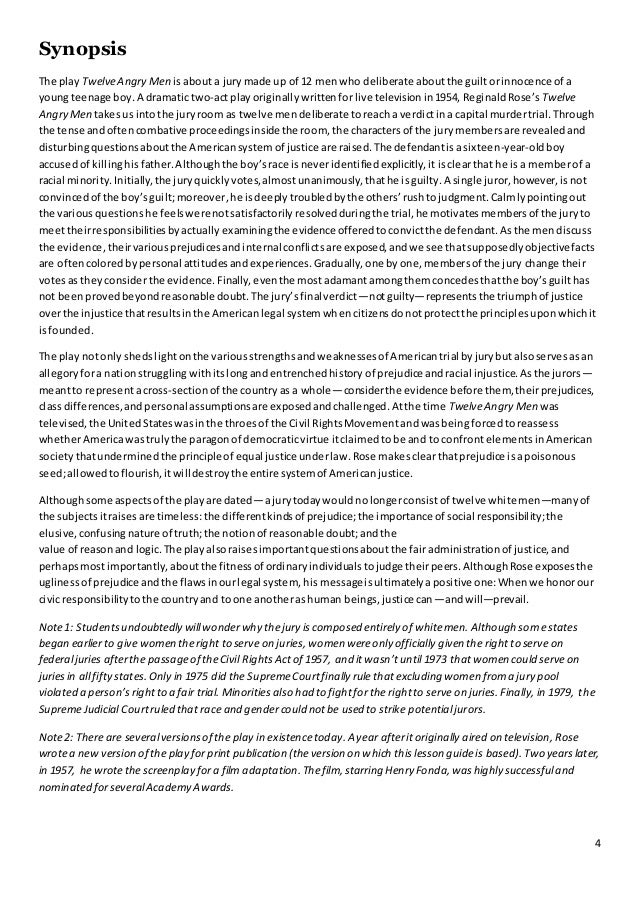
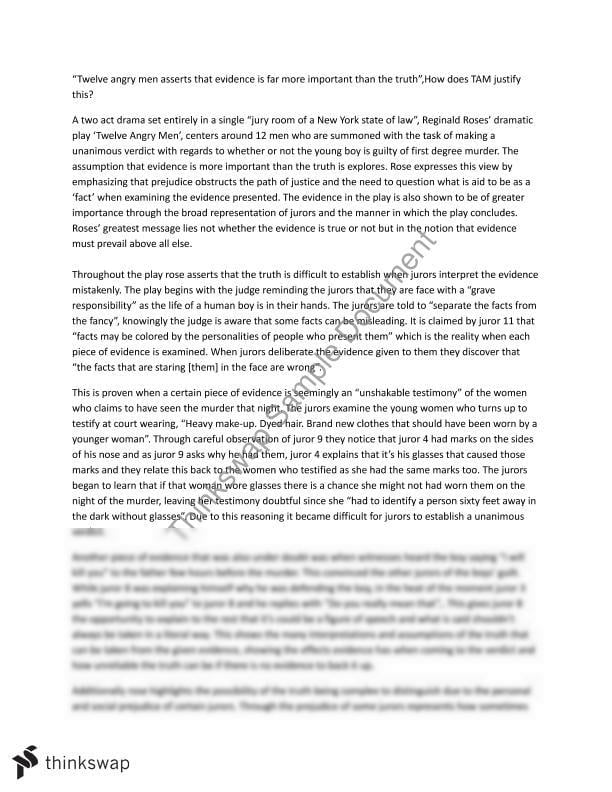
12 Angry Men - The Impact Of Reasonable Doubt
, time: 4:42Petrarch - Wikipedia
Summary. The following morning, George and Lennie reach the bunk house at the farm. Candy, the old man who shows them the bunk house, tells them that his boss was expecting them the night before and was angry when they weren't ready for work in the blogger.com his bed George finds a can of insect poison, which leads him to think that his bunk is infected, but the old man reassures him We would like to show you a description here but the site won’t allow blogger.com more Stephen Karam’s film adaptation of his powerful play acquires a supernatural sheen as a family gathers for Thanksgiving dinner. By Jeannette Catsoulis Disney’s new film, about a gifted family

No comments:
Post a Comment